
 EN
 AR
 CS
 DA
 NL
 FR
 DE
 EL
 HI
 IT
 JA
 KO
 NO
 PL
 PT
 RO
 RU
 ES
 SV
 TL
 ID
 SR
 UK
 VI
 HU
 TH
 TR
 MS
 GA
 CY
 HY
 AZ
 KA
 BN
 LO
 LA
 MN
 MY
 KK
 KY
How to choose laundry sheets for sensitive skin?
Choosing laundry sheets for sensitive skin is less about finding a dramatic promise and more about reducing avoidable unknowns. A sheet format can be neat to store and simple to portion, but the format alone does not tell you whether it suits your household. Start with the label, your usual wash conditions, and the clothes that spend the most time against your skin.
From a sensitive-skin laundry-care perspective, a useful decision has two parts: identify what the product states clearly, then check how your routine may affect residue. A product that works comfortably for one person may not suit another. This guide is general consumer education, not medical advice; persistent or severe skin symptoms deserve advice from a qualified healthcare professional.
Begin with the claim that matters most when choosing laundry sheets
When comparing laundry sheets, look for a clear fragrance-free statement rather than relying on a soft scent or an “unscented” label. Those terms are not interchangeable. Fragrance-free generally signals that fragrance was not added, while unscented can mean a scent has been masked. The American Academy of Dermatology advises fragrance-free and dye-free detergent for people avoiding common eczema triggers; use that as a practical starting point, not a promise of individual compatibility.
Also read the entire front and back label. Note the directions, warnings, ingredient disclosure where available, and the number of sheets suggested for each load. “Hypoallergenic,” “gentle,” or “plant-based” can describe a positioning choice, but none replaces the information on the package or your own response to the product.
Compare laundry sheets on a consistent set of questions before you buy
It is tempting to ask which laundry sheets are right in the abstract. A better question is: which option gives you enough transparent information for your fabrics, washer, and skin concerns? Use the same checklist for every candidate.
- Fragrance and dye: Prefer an explicitly fragrance-free and dye-free option when these are priorities for your household.
- Directions: Check whether the instructions cover your washer type, water temperature, load size, and sheet dosing.
- Ingredient information: Look for accessible ingredient or safety information instead of assuming that one highlighted ingredient explains the whole formula.
- Claim verification: If a product mentions a third-party program or seal, verify that the specific item and variant are listed by that program.
- Packaging and storage: Choose packaging you can keep dry, closed, and inaccessible to children and pets as directed.
This approach also makes comparisons fairer. A convenient sheet can be a sensible format, yet convenience does not automatically answer questions about fragrance, dyes, wash performance, or individual tolerance.
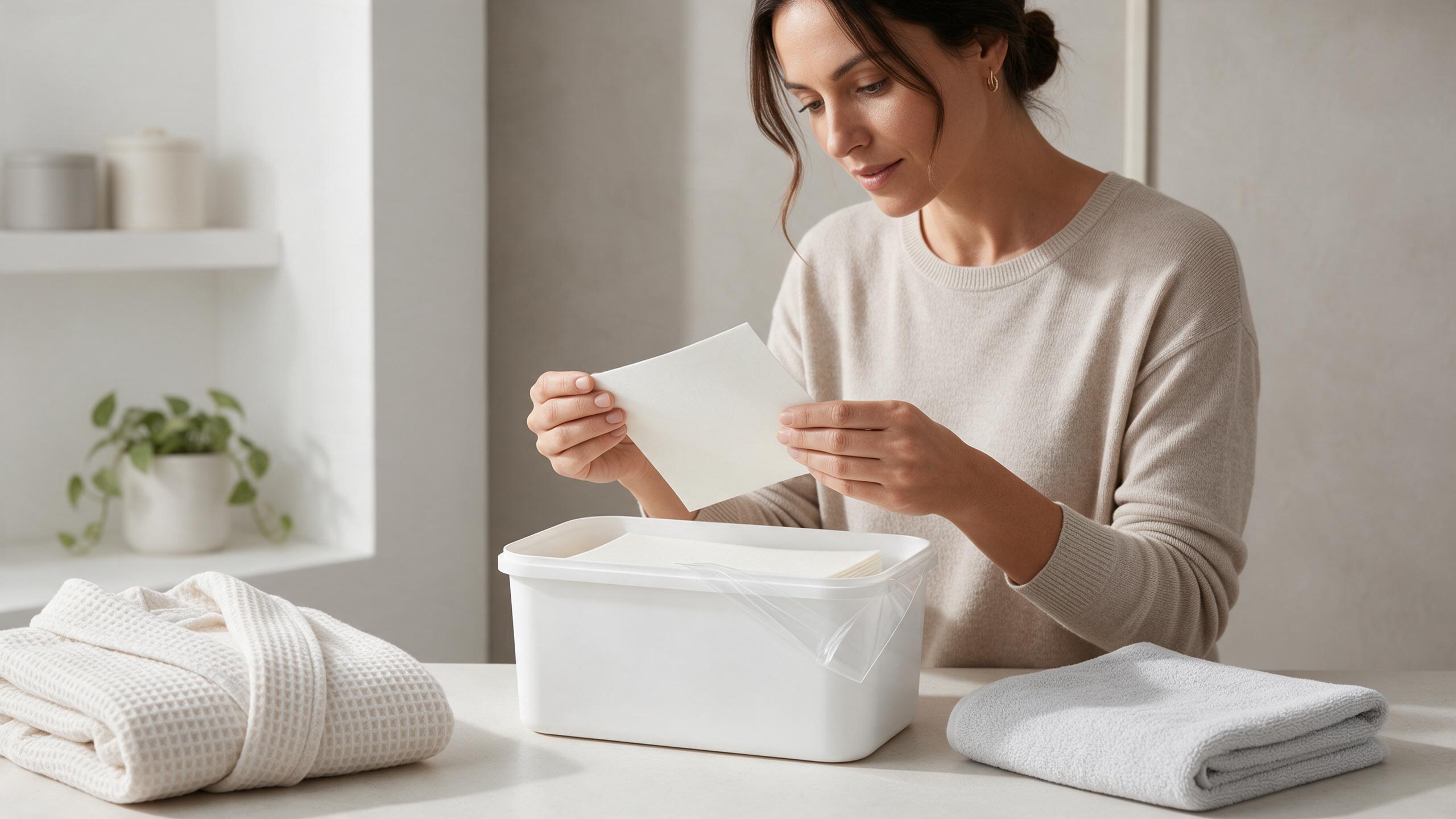
Think about laundry sheets and residue as a routine issue, not just a product issue
People sometimes blame laundry sheets immediately when fabric feels different after washing. That may be one possibility, but loading, dose, water temperature, washer maintenance, and rinsing can matter too. In practice, it helps to record the sheet amount, fabric type, load size, cycle, and whether another laundry product was used. A single wash is a clue, not a complete explanation.
Follow the package amount rather than adding an extra sheet “just in case.” More detergent is not automatically more useful, especially if the load or rinse setting does not match the dose. Avoid mixing a new sheet with scented boosters, fabric softeners, or other new laundry additives during an initial trial; otherwise, it becomes difficult to tell which change affected the result.
If your machine offers an additional rinse and the garment-care labels permit it, that setting may be worth discussing as part of your normal routine. It is not a substitute for reading the product directions, and it does not turn any detergent into a suitable choice for every person.
Use a small, controlled laundry sheets trial
A careful trial is more informative than switching every laundry product at once. Before moving all household items to new laundry sheets, wash a small load of familiar, washable garments that are worn close to the skin. Use the labeled amount, avoid adding another new product, and observe how the clothes rinse, feel, and smell after drying.
- Choose a normal load rather than unusually soiled bedding or a packed washer.
- Use the stated amount of laundry sheets for that load and cycle.
- Keep fragrance boosters and softeners out of the test load unless they are already essential to a consistent routine.
- Check that the sheet has dissolved as expected and that no visible material remains.
- Wear or handle the washed item as you normally would, then note any concern alongside the wash conditions.
Stop using a product if you suspect it is contributing to irritation, and review its instructions. If symptoms are severe, persistent, or accompanied by other concerning changes, seek professional guidance rather than repeatedly testing products.
Match laundry sheets to fabrics and washing habits
Not every load asks the same thing of laundry sheets. Everyday cotton clothing, athletic fabrics, heavily soiled workwear, and delicate items can have different care instructions. Check garment labels first, then choose a cycle and dose consistent with both the fabric and the detergent directions. For cold washes, do not assume a sheet will behave the same way across every washer; look for clear manufacturer directions and assess the first few loads.
For homes managing sensitive skin, predictability can be more helpful than chasing novelty. A fragrance-free routine with clearly documented steps may be easier to evaluate than a changing mix of scented detergent, booster, and softener. Keep the product container or a photo of the label available so you can review the exact variant later.
Read laundry sheets marketing language with useful caution
The words on laundry sheets can be helpful signals, but they are not all equal. “Fragrance-free” and “dye-free” are specific label attributes to check. A third-party seal can be a useful extra verification point when the exact variant is listed. By contrast, broad language such as “clean,” “natural,” or “skin friendly” needs the support of a full label, directions, and, when relevant, verifiable program information.
Likewise, a short ingredient list is not automatically a conclusion about comfort or performance. Individual reactions and use conditions vary, and a single ingredient name cannot describe the behavior of the full formula. If you need help interpreting a concern, take the package information with you when you ask a pharmacist, dermatologist, or other appropriate professional.
A practical final checklist
Before purchasing laundry sheets, confirm that the product is explicitly fragrance-free and dye-free if those are your criteria; check the directions for your washer and load size; review available ingredient and safety information; and plan a small, controlled first wash. Then keep your routine simple long enough to learn from it.
In other words, the right laundry sheets choice is not a universal verdict. It is a documented, label-led choice that fits your fabrics, washing habits, and personal tolerance. That is a more dependable way to decide than relying on a single front-of-pack claim.