
 EN
 AR
 CS
 DA
 NL
 FR
 DE
 EL
 HI
 IT
 JA
 KO
 NO
 PL
 PT
 RO
 RU
 ES
 SV
 TL
 ID
 SR
 UK
 VI
 HU
 TH
 TR
 MS
 GA
 CY
 HY
 AZ
 KA
 BN
 LO
 LA
 MN
 MY
 KK
 KY
What cationic surfactant level suits fabric softener concentrates?
For a concentrated fabric softener, the useful question is not “What percentage should I use?” in isolation. It is “What active level delivers the intended dose while remaining stable, pourable, compatible with the rest of the system, and appropriate for the package and use directions?” From a household-cleaning formulation perspective, the cationic surfactant is a functional starting point, but it cannot by itself predict how the finished fabric softener will behave.
A practical first distinction helps. The active content of a supplied cationic raw material is not the same as the active level in the finished fabric softener. If a supplier’s dispersion or flakes are not fully active, the addition rate must be converted to active matter before a target can be compared. Then the concentrate still needs to be checked as a whole: water level, fragrance, preservative system, electrolyte, processing route, rheology modifier, temperature history, and pack format all influence the result.
Start with the product claim and the in-use dose
Set the target from the dose per wash, not from a percentage copied from another formula. A concentrated fabric softener usually aims to deliver a meaningful conditioning dose from a smaller pour. That changes the design problem: the cationic active must disperse predictably in the rinse, deposit under the intended wash conditions, and still allow a consumer to measure and pour the product.
Historical patent literature describes conventional fabric-softener systems as commonly using roughly 3–7% active ingredients. This is useful context, but it is not a universal modern specification. Other disclosed systems reach much higher softener contents—one publication describes formulations up to about 40 weight percent under specific formulation conditions. That disclosure does not set a 40% target. It shows why concentration must be designed with phase behavior and dispensing performance in view.
For a new concentrate, define these inputs before selecting a cationic surfactant level:
- the intended milliliters per load and the assumed wash-load range;
- the active matter of the chosen cationic raw material;
- the target softness, lubrication, antistatic, and fragrance-delivery profile;
- the expected water hardness, rinse conditions, and textile mix where the product will be evaluated; and
- the bottle, cap, pump, or dosing chamber that determines acceptable flow behavior.
In other words, a higher active level may reduce dose volume, but it can also change viscosity, structure, and temperature sensitivity. More is not automatically more suitable.
Why the cationic active is only one part of the system
Long-chain cationic surfactant-like materials are widely used as conditioning actives in fabric softener formulations because they can associate with textile surfaces during the rinse. Esterquat-based materials are common examples in this category. Still, the ingredient name alone is not a performance result. Chain distribution, active assay, physical form, co-ingredients, pH, and process conditions can all alter the dispersed structure of the finished fabric softener.
Concentrate development can become counterintuitive at this point. Raising active matter can create a denser internal structure. Depending on the system, that may make the product too thick, stringy, difficult to fill, or prone to viscosity drift. Trying to correct that only by adding water can then change the product’s dose logic and preservation burden. A formulation team should therefore assess active level, rheology control, and process sequence as a connected set of decisions.
A useful selection framework for concentrate levels
1. Convert every proposal to finished-product active matter
Record the supplier assay and calculate the cationic active in the total batch. Do not compare a 15% addition of one raw material with a 15% addition of another unless their actives are identical. It is a simple calculation, yet it prevents a common communication gap between purchasing, formulation, and quality teams.
2. Build a small concentration ladder
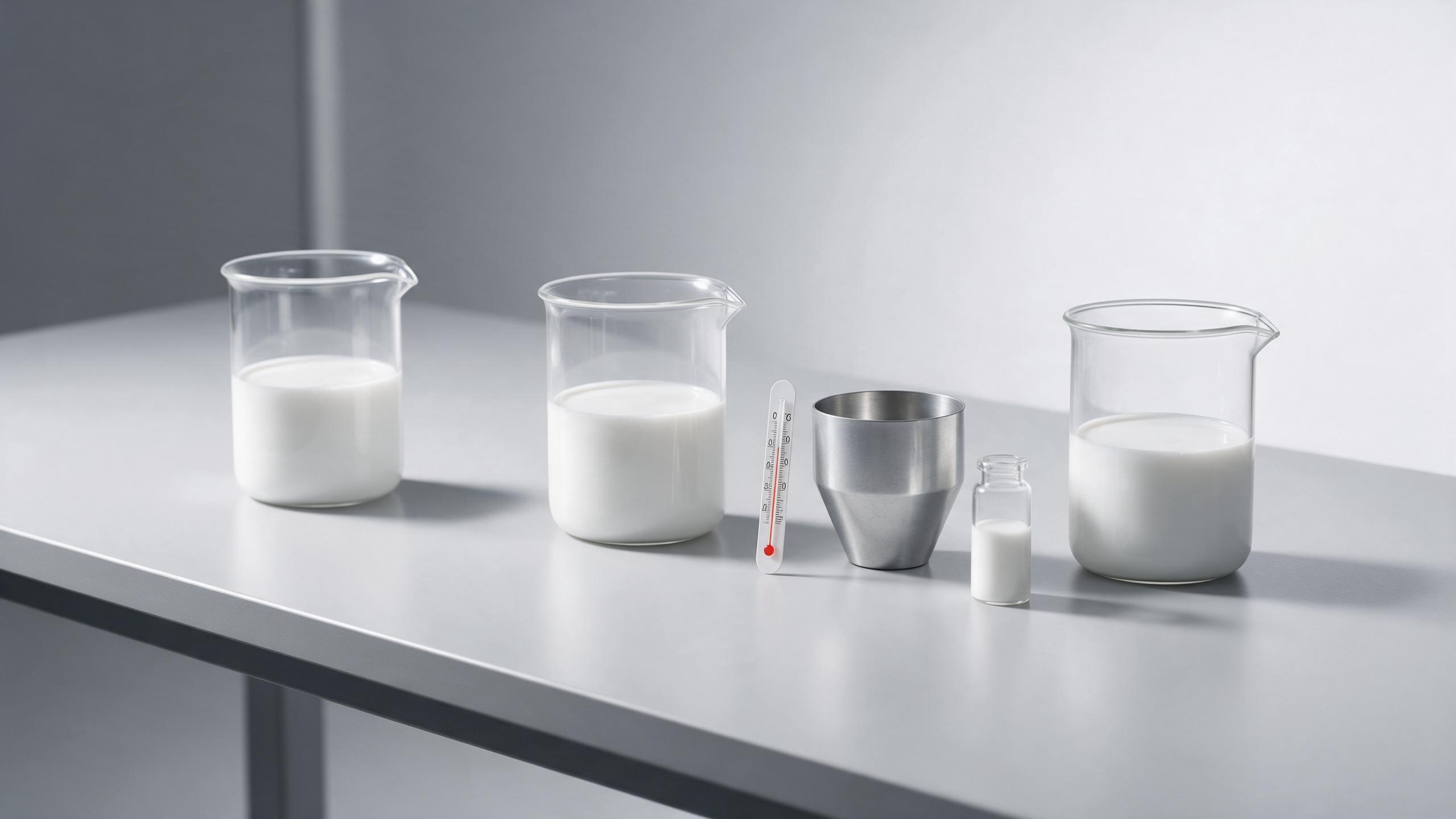
Instead of choosing one number first, prepare a controlled ladder around the intended positioning—for example, a lower, center, and higher finished-product active level that remain within the raw-material supplier’s documented handling guidance. Keep fragrance load, pH target, water quality, processing temperature, and mixing energy controlled. The purpose is to identify a workable operating window for that specific fabric softener, not to establish a general formula.
3. Judge stability before making consumer-facing claims
Check each candidate after manufacture and through an agreed storage plan. Useful observations include appearance, phase separation, sediment or floating material, odor change, pH, viscosity, redispersibility, pour behavior, and package interaction. A sample that looks acceptable on day one may change after cold exposure, elevated temperature, or repeated temperature cycling. If the product will be shipped across varied climates, those conditions should be included in the validation plan.
4. Test in the intended rinse conditions
Bench viscosity is not a substitute for in-use assessment. Evaluate the candidate fabric softener at its intended dose and dilution under representative water conditions and on relevant textiles. Compare the sensory outcome and any undesirable residue or handling observations against the stated target. A single cationic percentage cannot establish compatibility with every detergent carryover, washer type, or textile blend.
Fabric softener concentrate review matrix
Use the same review sheet for every candidate. The matrix keeps the fabric softener discussion tied to observations rather than an assumed universal level.
| Fabric softener review point | What to record for the fabric softener candidate |
|---|---|
| Fabric softener active basis | Record the supplied active assay and finished-batch calculation. |
| Fabric softener dose | State the intended milliliters per wash and rinse dilution. |
| Fabric softener flow | Measure pour behavior in the intended bottle and cap. |
| Fabric softener appearance | Check for separation, sediment, or floating material. |
| Fabric softener pH | Document the agreed target and the measurement method. |
| Fabric softener viscosity | Use one defined method, temperature, and spindle condition. |
| Fabric softener storage | Record time, temperature, and any cycling exposure. |
| Fabric softener fragrance | Confirm whether the fragrance changes structure or odor over time. |
| Fabric softener water | Note the water source and hardness used for assessment. |
| Fabric softener textiles | List the fabrics and loading conditions in the rinse evaluation. |
| Fabric softener package | Inspect the final pack for leakage, deformation, and dispensing changes. |
| Fabric softener batch record | Keep raw-material lots, mixing order, and temperature history. |
| Fabric softener acceptance | Separate observed results from pending verification items. |
| Fabric softener revision | Change one controlled variable at a time where possible. |
| Fabric softener sample ID | Link every observation to the exact batch and storage sample. |
| Fabric softener release | Approve only after the agreed performance and documentation review. |
A fabric softener review matrix is not a substitute for supplier guidance or local requirements. It is a way to make fabric softener concentration decisions traceable. When a fabric softener sample changes, compare its record against the center formula before adjusting active matter. This lets the fabric softener team see whether the cause is level, process, fragrance, water, or storage. For a private-label fabric softener project, share the accepted test conditions with both quality and packaging teams.
Common signals that the level or system needs adjustment
A concentrate may need reformulation when it no longer pours consistently, develops visible separation, changes sharply in viscosity after storage, or shows an in-use result that does not align with the dosing claim. These signals do not prove that the cationic surfactant level alone is at fault. First review the full record: raw-material lot, active assay, water quality, batch temperature, addition order, shear history, pH, fragrance, and storage conditions.
A record-first approach is especially useful in supplier communication. Rather than saying a fabric softener is “too concentrated,” state what was observed, at what temperature, after how long, in which package, and at what measured active matter. This separates an initial formulation hypothesis from a verified finding.
How to document a defensible target
For each candidate level, maintain a concise development sheet with the finished-product cationic active, raw-material assay, batch instructions, target pH, viscosity method, storage conditions, dose per load, and acceptance observations. If the product will be sold in multiple markets, keep labeling, safety, and local regulatory review as separate approval steps; a formulation range does not establish market compliance.
For a B2B inquiry or private-label project, it is also helpful to ask what the buyer means by “concentrate.” Do they mean a smaller dose, a particular bottle size, a target active level, a particular flow profile, or all of these? Clarifying that point early is often more productive than starting with an unqualified percentage.
Bottom line
The suitable cationic surfactant level for a concentrated fabric softener is a validated operating range, not a universal figure. Historical 3–7% active context can help frame conventional products, while higher-concentration disclosures show that other systems are possible when rheology and stability are deliberately engineered. Start from the intended in-use dose, calculate finished-product active matter, screen a controlled concentration ladder, and retain only the levels that meet agreed stability, pourability, and rinse-performance checks. Before release, confirm the formula against supplier documentation, applicable requirements, and the final package.